MBTA
Run more trains.
One could digress:
- Better (not lesser) service during construction and disruption.
- Improvement of daytime operations before late night (are you listening sponsors?).
- Tooth on-time guarantees.
- Expresses (over holds).
- Address dangerous platform overcrowding at rush hour.
- Out-of-servicing only in sparsely-populated direction.
- All (or most) Green-lines inbound to at least North Station.
- No schedule adjustments at core and terminus stations.
But to get back to the crux...
Run more trains.
Showing posts with label trains. Show all posts
Showing posts with label trains. Show all posts
Wednesday, April 30, 2014

Thursday, March 28, 2013
PBS - America Revealed - Yul Kwon
My wife happened by this television program, and put me onto America Revealed on PBS http://www.pbs.org/america-revealed/
Host Yul Kwan http://en.wikipedia.org/wiki/Yul_Kwon
Stories on transportation, manufacturing, energy and food http://www.pbs.org/america-revealed/story/
Have interest in them all. Have blogged on these topics. The series presentations have something for everyone. Learned something from each.
Host Yul Kwan http://en.wikipedia.org/wiki/Yul_Kwon
Stories on transportation, manufacturing, energy and food http://www.pbs.org/america-revealed/story/
Have interest in them all. Have blogged on these topics. The series presentations have something for everyone. Learned something from each.
Monday, July 30, 2012
Hara Model Railway Museum near JR Yokohama Station

http://en.wikipedia.org/wiki/Hara_Model_Railway_Museum
http://www.hara-mrm.com/index.html (Japanese only?)
Here is a small plain webpage for train displays near and around Nagoya. http://kikuko-nagoya.com/html/railroad.html
This is somewhat similar. http://www.kisekigo.com/jrmus/
Went to SC Maglev and Railway Park in Nagoya this spring http://en.wikipedia.org/wiki/SCMaglev_and_Railway_Park
via Aonami line.
http://museum.jr-central.co.jp/en/access/
Visited the old transportation museum in Chiyoda in Tokyo in 2005. Tried to visit the new Tokyo transportation museum in 2009.
http://en.wikipedia.org/wiki/Railway_Museum_(Saitama)
http://www.railway-museum.jp/en/information.html
BUT went on a Tuesday!
Monday, August 30, 2010
Trip to Russia in 2003.
In 2003 visited Russia. Flew into London and spent the morning there and then headed out to Moscow, Domodedovo.
http://en.wikipedia.org/wiki/Domodedovo_International_Airport
Domodedovo was actually under re-construction at the time I passed through in 2003.
Stayed at Hotel Rossiya (now gone - apparently demolition started in 2006). http://en.wikipedia.org/wiki/Rossiya_Hotel,_Moscow
Here is a view out the window of my room looking northwards.

Saw many interesting areas, like the Arbat
http://en.wikipedia.org/wiki/Arbat
and Kremlin.
http://en.wikipedia.org/wiki/Kremlin
Here I am inside the Kremlin near one of the churches.

Was very pleased to take an overnight train to Kazan. It was sort of an "Orient Express" on the economy-plan so far as I was concerned, though my gracious Russian hosts thought it rather expensive and inconvenient I think.
Here I am in the carriage at Kazansky vokzal, just a few minutes before departure

http://en.wikipedia.org/wiki/Kazansky_Rail_Terminal
Kazansky station had one of the biggest platforms I have ever seen (bigger than in London and Japan - and that says something) and the train had more carriages than any I had ever seen.
One of my most vivid memories of that trip is that the train ran late and we sat on a siding just before the bridge into Kazan in the early morning waiting for passing traffic. It was snowing and we were near a small village. It was peaceful, and intriguing to watch the villagers go about their early morning business. There were a few cars and trucks, mostly people were our for a walk. Given no automobiles, it could have been the turn of the century.
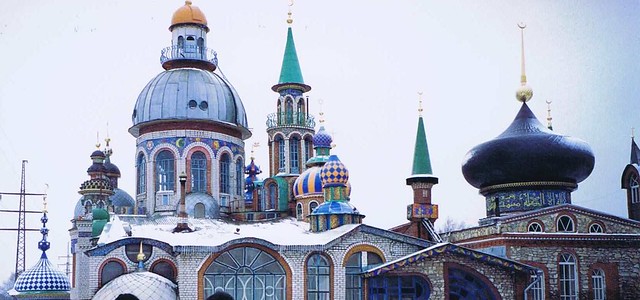
In Kazan my hosts showed me great hospitality. Stayed at a very nice spa near the Volga. We had some great meals in restaurants and in my hosts's homes. Saw many interesting and historic sites in Kazan. I especially remember the building with spires of many religions.

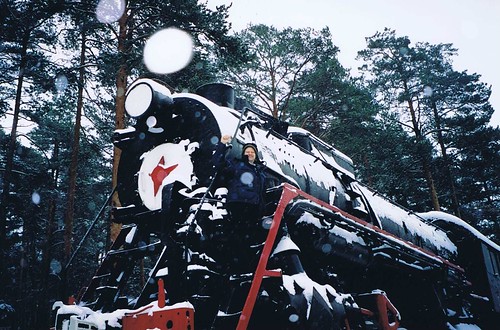
And my hosts took me out to a Russian (in name/type, place and ownership *smile*) 2-10-0 locomotive.

Also passed a display of the Buran (or variant) at one of the institutes
http://en.wikipedia.org/wiki/Buran_program
http://en.wikipedia.org/wiki/Buran_(spacecraft)
but it might have been a BOR-4 or other relative.
Took the train back to Moscow, and the plane out from Domodedovo, and then back to London for a few days with my wife (business and sightseeing).
http://en.wikipedia.org/wiki/Domodedovo_International_Airport
Domodedovo was actually under re-construction at the time I passed through in 2003.
Stayed at Hotel Rossiya (now gone - apparently demolition started in 2006). http://en.wikipedia.org/wiki/Rossiya_Hotel,_Moscow
Here is a view out the window of my room looking northwards.
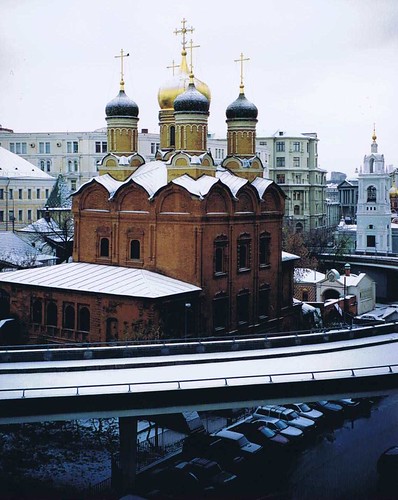
Saw many interesting areas, like the Arbat
http://en.wikipedia.org/wiki/Arbat
and Kremlin.
http://en.wikipedia.org/wiki/Kremlin
Here I am inside the Kremlin near one of the churches.

Was very pleased to take an overnight train to Kazan. It was sort of an "Orient Express" on the economy-plan so far as I was concerned, though my gracious Russian hosts thought it rather expensive and inconvenient I think.
Here I am in the carriage at Kazansky vokzal, just a few minutes before departure
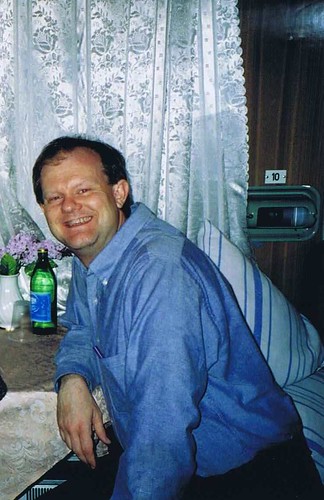
http://en.wikipedia.org/wiki/Kazansky_Rail_Terminal
Kazansky station had one of the biggest platforms I have ever seen (bigger than in London and Japan - and that says something) and the train had more carriages than any I had ever seen.
One of my most vivid memories of that trip is that the train ran late and we sat on a siding just before the bridge into Kazan in the early morning waiting for passing traffic. It was snowing and we were near a small village. It was peaceful, and intriguing to watch the villagers go about their early morning business. There were a few cars and trucks, mostly people were our for a walk. Given no automobiles, it could have been the turn of the century.
In Kazan my hosts showed me great hospitality. Stayed at a very nice spa near the Volga. We had some great meals in restaurants and in my hosts's homes. Saw many interesting and historic sites in Kazan. I especially remember the building with spires of many religions.
And my hosts took me out to a Russian (in name/type, place and ownership *smile*) 2-10-0 locomotive.
Also passed a display of the Buran (or variant) at one of the institutes
http://en.wikipedia.org/wiki/Buran_program
http://en.wikipedia.org/wiki/Buran_(spacecraft)
but it might have been a BOR-4 or other relative.
Took the train back to Moscow, and the plane out from Domodedovo, and then back to London for a few days with my wife (business and sightseeing).
Monday, August 16, 2010
Trip to Japan 2005
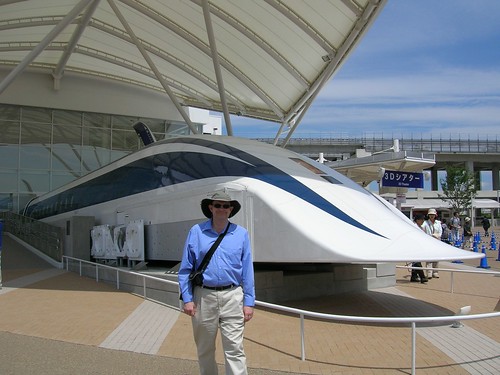
My wife and I visited Japan in 2005. We went to the Aichi Expo
http://www.expo2005.or.jp/en/
http://en.wikipedia.org/wiki/Expo_2005
Saw lots of Morizo and Kiccoro. Saw many interesting exhibits, including ones about new high speed trains.

Also got to see Satsuki and Mei's house at the Expo...
http://en.wikipedia.org/wiki/My_Neighbor_Totoro
http://en.wikipedia.org/wiki/File:Expo_2005_of_Satsuki_and_Mei%E2%80%99s_House_01.jpg
Also got to visit Kyoto and Nara.
http://en.wikipedia.org/wiki/Nara,_Nara
The deer at Nara are adorable, but also very very cheeky (read aggressive). Watch your back when you feed them wafers!

Saw the (possibly) largest wooden building at Todai-ji
http://en.wikipedia.org/wiki/T%C5%8Ddai-ji
And (possibly) the oldest wooden building at Horyu-ji
http://en.wikipedia.org/wiki/H%C5%8Dry%C5%AB-ji
These are just two of many National Treasures of Japan
http://en.wikipedia.org/wiki/List_of_National_Treasures_of_Japan_(temples)
http://www.expo2005.or.jp/en/
http://en.wikipedia.org/wiki/Expo_2005
Saw lots of Morizo and Kiccoro. Saw many interesting exhibits, including ones about new high speed trains.
Also got to see Satsuki and Mei's house at the Expo...
http://en.wikipedia.org/wiki/My_Neighbor_Totoro
http://en.wikipedia.org/wiki/File:Expo_2005_of_Satsuki_and_Mei%E2%80%99s_House_01.jpg
Also got to visit Kyoto and Nara.
http://en.wikipedia.org/wiki/Nara,_Nara
The deer at Nara are adorable, but also very very cheeky (read aggressive). Watch your back when you feed them wafers!

Saw the (possibly) largest wooden building at Todai-ji
http://en.wikipedia.org/wiki/T%C5%8Ddai-ji
And (possibly) the oldest wooden building at Horyu-ji
http://en.wikipedia.org/wiki/H%C5%8Dry%C5%AB-ji
These are just two of many National Treasures of Japan
http://en.wikipedia.org/wiki/List_of_National_Treasures_of_Japan_(temples)
Thursday, January 21, 2010
Ideas for a first time traveller to Japan
Ideas for first trip to Japan.
1. Go with someone who has been to Japan.
2. Keep to areas of navigation where at least some signs are in English. That would say stay in Tokyo and Osaka and stick to train lines between city locations and to and from the airport.
3. It is a cash based society. So take/acquire cash. Get some from those who have been before. Check if your ATM will work with some of the big banks and withdraw in local currency. UBJ comes to mind.
4. DO NOT drive.
5. No special visa is required for Japan for US, Canadian/Commonwealth citcizens.
6. Fly JAL or ANA if you can afford it. Their service is much better than United, Northwest and American and on the long flight it is worth it.
7. Get a phrasebook and try to get the following:
-W5 (Who, What, Where, When, Why) and How,
-Greetings (bear in mind honorific and differences in first greetings vs later and family),
-Numbers (though deeper topic than expected in Japanese where counting depends on what is counted),
-Phrases for transit/directions, fast food, restaurants, washrooms, and your hobby/work/interests.
-Basic alphabet/syllabary (go for Katakana for foreign words first - more fun)
-Something interesting related to your work/goal/hobby (just one or two words).
-"Particles" are interesting to give you a picture of how the language works.If it helps the techno-types, Japanese is more of a stack context language than most. If you push an item onto the stack/context in a given role, it remains until you change that item.
8. Get a JR railpass (period - unless you are only there for a few days). There is no better mass-transit/train-pass deal in the world, and for any techno-types the Shinkansen is a must see. In Tokyo and Osaka the JR "subway" system is extremely useful. So even if you never leave Tokyo the JR Railpass is a great deal. Do not hesitate to try a short Shinkansen hop (like say out to Yokohama and back). Or ride out to the first stop north of Ueno and back. If you do rides at times of fair density you will only have to wait a few minutes for the return trip on major lines... or try a local train. Learn the stops on the Yamanote or Osaka-Loop Line.
9. See a museum related to your field.
10. Eat at Depato. Go to top floors or basement. Look at food models. Try something new. Enjoy. You will not generally run into anything too exotic first time out in a food hall (no fugu or whale or dolphin or horse or...). Try katsu. Try tempura.
11. Pick a cultural site to see. Tokyo: Asakusa Temples, Akihabara Electronic Town, Imperial Palace, Meiji Park, Ueno Park/Zoo, Tokyo University. Osaka: Temples, Den Den Town, shopping arcades.
12. Get an international cell phone plan or a Skype/SIP type device for WiFi. Getting plans inside Japan is hard becasue of ID and residency requirements (in post 9/11 world).
13. Japan is safe. If someone looks like they will help you, ask them for help. Accept their graciousness and be polite.
14. Exchange of business cards is important. You only get one shot at getting it right at first meeting. Have your cards clean and near at hand. Hand it over with two hands facing the recipient. Accept with two hands from those giving. Consider the card a moment. A polite question is not inappropriate (like what part of Yokohama is this district in your address? Or how do you exactly pronounce "x"?). Status is often assessed by card exchange.When you put away cards do not shove them in pants pockets. Show the card the same respect as the giver. Put it in a jacket pocket or a case or in your portfolio.
15. Stay at an international hotel near a JR station on a major metropolitan rail line. Leave ryokan and minshuku and such for later trips.
16. If you go off the beaten path in a metro area, you will probably get lost unless you have a great sense of absolute direction. It is not much of a worry if you have time to shift around a bit. Japan is safe. Try to find a map at an intersection. Try to get to a JR station.
17. Toilets: Western/Asian. Most hotels and department stores have western style toliets (at least as an option). It is helpful to know the Kanji for male/female in some off the beaten path spots, but if the postings are only in Kanji you will probably only get Asian style toilets.Carry some tissue (and a handkerchief?) with you. Some public toilets have no toilet paper or paper towels or dryers.Tissue lucklily is easy to come by from all the hawkers near major JR stations, shopping districts and department stores. Do not be offended by hawker snubs. It is probably more the case that hawkers are targetting male/females then Asian/foreign recipents. Be thankful you do not end up carrying arround tissues which have advertisements for hygiene products for the opposite sex.
18. Watch out for language restrictions in Internet/WiFi and web access. Not saying they will be there, but they have tripped users up before.
The following little PDF might be interesting...
http://www.links.net/vita/trip/japan/tokyo/guide/
http://www.links.net/vita/trip/japan/tokyo/guide/onscreen.html
Search for "Justin Tokyo" or "Just in Tokyo".
1. Go with someone who has been to Japan.
2. Keep to areas of navigation where at least some signs are in English. That would say stay in Tokyo and Osaka and stick to train lines between city locations and to and from the airport.
3. It is a cash based society. So take/acquire cash. Get some from those who have been before. Check if your ATM will work with some of the big banks and withdraw in local currency. UBJ comes to mind.
4. DO NOT drive.
5. No special visa is required for Japan for US, Canadian/Commonwealth citcizens.
6. Fly JAL or ANA if you can afford it. Their service is much better than United, Northwest and American and on the long flight it is worth it.
7. Get a phrasebook and try to get the following:
-W5 (Who, What, Where, When, Why) and How,
-Greetings (bear in mind honorific and differences in first greetings vs later and family),
-Numbers (though deeper topic than expected in Japanese where counting depends on what is counted),
-Phrases for transit/directions, fast food, restaurants, washrooms, and your hobby/work/interests.
-Basic alphabet/syllabary (go for Katakana for foreign words first - more fun)
-Something interesting related to your work/goal/hobby (just one or two words).
-"Particles" are interesting to give you a picture of how the language works.If it helps the techno-types, Japanese is more of a stack context language than most. If you push an item onto the stack/context in a given role, it remains until you change that item.
8. Get a JR railpass (period - unless you are only there for a few days). There is no better mass-transit/train-pass deal in the world, and for any techno-types the Shinkansen is a must see. In Tokyo and Osaka the JR "subway" system is extremely useful. So even if you never leave Tokyo the JR Railpass is a great deal. Do not hesitate to try a short Shinkansen hop (like say out to Yokohama and back). Or ride out to the first stop north of Ueno and back. If you do rides at times of fair density you will only have to wait a few minutes for the return trip on major lines... or try a local train. Learn the stops on the Yamanote or Osaka-Loop Line.
9. See a museum related to your field.
10. Eat at Depato. Go to top floors or basement. Look at food models. Try something new. Enjoy. You will not generally run into anything too exotic first time out in a food hall (no fugu or whale or dolphin or horse or...). Try katsu. Try tempura.
11. Pick a cultural site to see. Tokyo: Asakusa Temples, Akihabara Electronic Town, Imperial Palace, Meiji Park, Ueno Park/Zoo, Tokyo University. Osaka: Temples, Den Den Town, shopping arcades.
12. Get an international cell phone plan or a Skype/SIP type device for WiFi. Getting plans inside Japan is hard becasue of ID and residency requirements (in post 9/11 world).
13. Japan is safe. If someone looks like they will help you, ask them for help. Accept their graciousness and be polite.
14. Exchange of business cards is important. You only get one shot at getting it right at first meeting. Have your cards clean and near at hand. Hand it over with two hands facing the recipient. Accept with two hands from those giving. Consider the card a moment. A polite question is not inappropriate (like what part of Yokohama is this district in your address? Or how do you exactly pronounce "x"?). Status is often assessed by card exchange.When you put away cards do not shove them in pants pockets. Show the card the same respect as the giver. Put it in a jacket pocket or a case or in your portfolio.
15. Stay at an international hotel near a JR station on a major metropolitan rail line. Leave ryokan and minshuku and such for later trips.
16. If you go off the beaten path in a metro area, you will probably get lost unless you have a great sense of absolute direction. It is not much of a worry if you have time to shift around a bit. Japan is safe. Try to find a map at an intersection. Try to get to a JR station.
17. Toilets: Western/Asian. Most hotels and department stores have western style toliets (at least as an option). It is helpful to know the Kanji for male/female in some off the beaten path spots, but if the postings are only in Kanji you will probably only get Asian style toilets.Carry some tissue (and a handkerchief?) with you. Some public toilets have no toilet paper or paper towels or dryers.Tissue lucklily is easy to come by from all the hawkers near major JR stations, shopping districts and department stores. Do not be offended by hawker snubs. It is probably more the case that hawkers are targetting male/females then Asian/foreign recipents. Be thankful you do not end up carrying arround tissues which have advertisements for hygiene products for the opposite sex.
18. Watch out for language restrictions in Internet/WiFi and web access. Not saying they will be there, but they have tripped users up before.
The following little PDF might be interesting...
http://www.links.net/vita/trip/japan/tokyo/guide/
http://www.links.net/vita/trip/japan/tokyo/guide/onscreen.html
Search for "Justin Tokyo" or "Just in Tokyo".
Saturday, January 9, 2010
"Let's start at the very beginning, a very good place to start"
Apologies to the writers allied with the "Sound of Music".
The first thing I have to figure out is how to make sure my postings go smootly to archive and I do NOT end up with a page that has to load over a thousand objects so that people can read my post from the middle of 2010.
My plan is to muse about energy and metrology and other things which interest me.
Those things might include:
Travel - like to Japan, Britain and Russia.
Trains - both real and in models and fiction - like in Japan and Europe.
Complex interfaces - like those in trains and air or space craft.
Energy - conserving it, measuring it, undestanding its science, technology and sociolology.
Virtual systems - machines, services and so on.
The first thing I have to figure out is how to make sure my postings go smootly to archive and I do NOT end up with a page that has to load over a thousand objects so that people can read my post from the middle of 2010.
My plan is to muse about energy and metrology and other things which interest me.
Those things might include:
Travel - like to Japan, Britain and Russia.
Trains - both real and in models and fiction - like in Japan and Europe.
Complex interfaces - like those in trains and air or space craft.
Energy - conserving it, measuring it, undestanding its science, technology and sociolology.
Virtual systems - machines, services and so on.
Subscribe to:
Posts (Atom)


